How it works
Four steps, and the proof travels with the document.
ProofLayer does not replace how you issue certificates. It attaches a proof to the document that anyone can check, anywhere, without asking you first.
- 01
Issue
The university issues the credential in ProofLayer — through the interface or straight from the campus system via API.
- 02
Anchor
A SHA-256 fingerprint is computed from the document and written to the public network with a timestamp.
- 03
Hand over
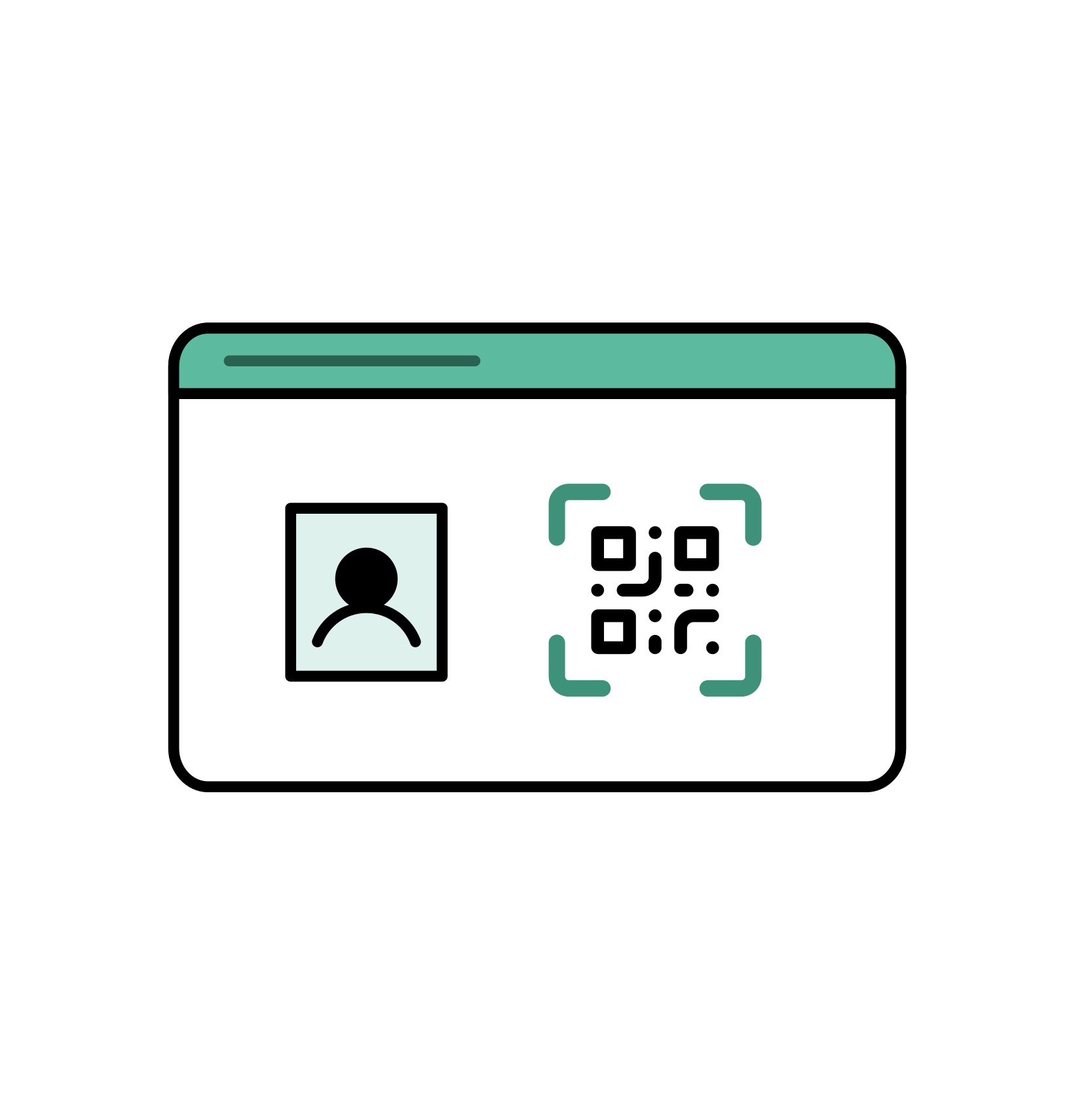
The graduate receives a PDF with a QR code — and, once available, the same credential in their EUDI wallet.
- 04
Verify
The verifier scans the QR code. Result in seconds: authentic, unaltered, not revoked — or not.
The decisive point: the QR code carries the proof coordinates itself. Whoever verifies queries a public node of the network directly — no ProofLayer account, no call to the registrar, no middleman. The credential checks itself against the network, not against us.
Under ten seconds per check. And nobody learns who verified what, or when.
Contact us for a demo
See issuance and verification on a real certificate — 30 minutes.
Why it cannot be forged
The fingerprint.
A calculation turns any document into a fixed character string. The same document always yields the same string — a changed document always a different one. The certificate cannot be reconstructed from the string, which is why anchoring it raises no data-protection concerns.
Original
Diploma · Anna Sample · M.Sc. · Grade 1.3
a23bba54 23767f49 fd8184ed f2f1de5a e6f09e4f 078bb320 7ac6338a 0577cc9d
One digit changed
Diploma · Anna Sample · M.Sc. · Grade 1.0
75ae25f4 75e2f027 96efeac5 4b2f5358 d6c76ae6 9ab1c2ab 3cda9411 71d7edca
Not reversible
No personal data can be read back out of the string.
Unique
Two different documents never produce the same string.
Sensitive
One changed comma and the string is completely different.
The difference in practice
What this changes on an ordinary Tuesday.
Revocation that actually arrives
When a degree is withdrawn — plagiarism, deception, retraction — ProofLayer writes a revocation event to the network. From that moment every check reads “revoked”, including a check on a PDF that has been circulating for years and whose copy you will never get back. No circular letter, no recall, no tracking required.
Selective disclosure
With SD-JWT credentials the graduate decides which claims to reveal. An employer can confirm that the degree exists, the institution is genuine and nothing was revoked — without seeing a date of birth, grades or a student number. Data minimisation here is not a promise, it is the architecture.
Trust is not claimed.
It is calculated.
Let us take one degree programme and show you. Four to six weeks, on the test network, with no production data.

Motseki Khoarai
Team Lead, Open Elements